
It's that time of year again, when I am called back to this beautiful place. Its vast central square surrounded by historic homes from an era past seems bathed by this golden light that slows down my weary and timeworn senses; shedding off the superficial shell that the city forces one to wear. Everywhere, even the faces of strangers turn into friends, and in their withdrawn yet polite smiles, comfort. Three years I have been coming back to this place, with one less stranger and a new friend made as I cross the streets, looking up at old house windows, praying inside Saint Anthony's brick and stone church, and enjoying the company of every new friend I have made.
Who would not fall in love with Pila?This historic town that traces its name as far back as the 10th century [the date was April 21, 900 AD] when the place was still called 'Pailah' as mentioned in a small fragment of an engraved sheet of metal called the Laguna Copper Plate; which I first heard mention of during my History 165 class at the Ateneo. But it would not be another eight years before I would actually walk the streets of Pila, ascend the steps of its century old homes, and watch the early morning sun illuminate this blessed place from the window of one of its old houses owned by a family that has welcomed me three years hence.

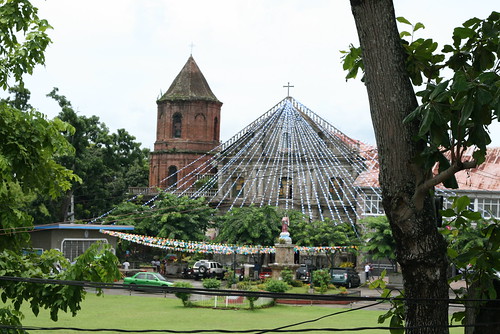
It was a rainy late afternoon when I arrived in Pila last June 11th, a day or so away from the annual celebration feast of San Antonio de Padua, the town's patron saint. Local lore has it that the Diocesan Shrine of San Antonio located at the edge of their Plaza Mayor [an old name for the central square, which is always more rectangular in the Philippines, I noticed] was actually transferred brick by brick and stone by stone from its old location by the lake, called Pagalangan of what is now the town of Victoria. It is said, during the Spanish colonial times, the Friars and the Luminaries of Pila decided to relocate the church due to the flooding of the Laguna de Bay. The new location, once known as Hacienda de Santa Clara, which was owned by the brothers Felizardo, Rafael, and Miguel de Rivera, is now the heart of modern day Pila. Without Don Felizardo Rivera's pioneering move, Pila would not have been. Rumor has it, the happy spirit of Don Felizardo still roams Pila, a sentinel of a time past.

It was three years ago when we were first invited by Ms. Jessica Rivera, one of the current heirs of the Rivera Ancestral House, to attend the annual Fiesta of San Antonio de Padua. Now for those of you who are uncommon to the Filipino tradition of celebrating a Fiesta, it's simply a community based celebration which has religious roots. Each town has a patron saint, and when the patron saint's feast day comes, it is celebrated with feasting and revelry to give thanks to the patron saint for gracing them with a good year of blessings and/or a good harvest. But I babble again...

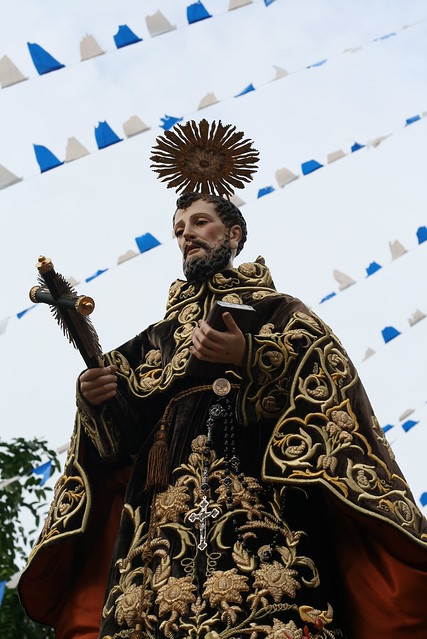
So, three years ago, a new found friend named Manuel [a distant relative of the Riveras] and I were invited by Miss Jessica Rivera for a traditional fiesta luncheon and the solemn procession of the image of San Antonio de Padua. Miss Rivera herself owns an image of San Francisco de Asis [the founder of the Franciscan Order] which accompanies San Antonio during his feast day procession along with the images of San Roque, and the Blessed Virgin Mary. It was an enjoyable experience and from then on, my fondness for the town of Pila began.

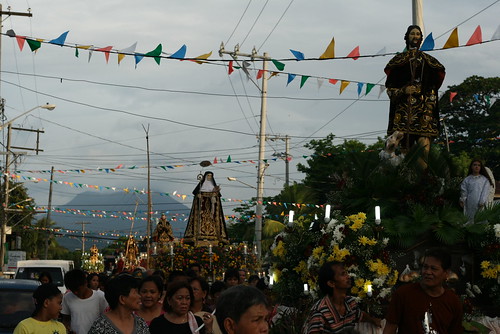
But Manuel felt that the processional images of San Antonio, San Francisco, and the others, must be accompanied by Santa Clara de Asis the next year, following the tradition that she is friend to San Francisco and took from his example. Add to that, since the town now stands where Hacienda de Santa Clara used to be, there was a certain serendipity. And come 2010, I began my devotion to what I call 'babysitting' Santa Clara de Asis. Manuel commissioned a processional image of the and founder and first abbess of the Poor Clares to join the procession in her saintly glory, while I volunteered to help supervise the logistics of taking out the image for procession ensuring that she arrives at the church door -inclusive of traversing bumpy roads, dodging electrical lines and festive buntings, and the occasional rain.

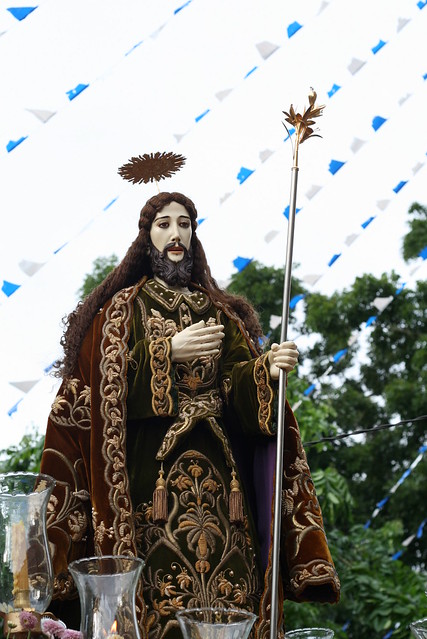
Meanwhile Doctor Rufino Francia, a cousin of Miss Jessica Rivera, also commissioned a processional image of Saint Joseph with face and hands made of ivory to escort the Blessed Virgin Mary. A stunning piece of statuary, Dr. Francia's San Jose was executed in the local sculptural style of the late 19th century wearing vestments of amber and green velvet embroidered with jilos de oro [metallic gold thread].

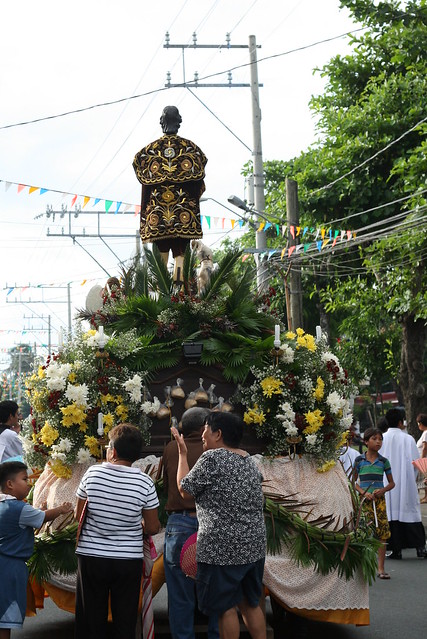
Another son of Pila, affectionately called Tito Vic, opens his home to the images of San Francisco, Santa Clara, San Jose, and the Blessed Virgin Mary. Under the old trees around his property, these sacred images make their temporary stop. The carrozas [wheeled processional mounts/platforms] are decked with flowers and other complimentary foliage, the arrangement artfully executed under the watchful eye of Tito Vic, making sure that every leaf and flower falls or stands rightly so. And after a full day's work, an hour before procession, the carrozas would make their way from his gates to the church courtyard, in their vibrant floral gloss.

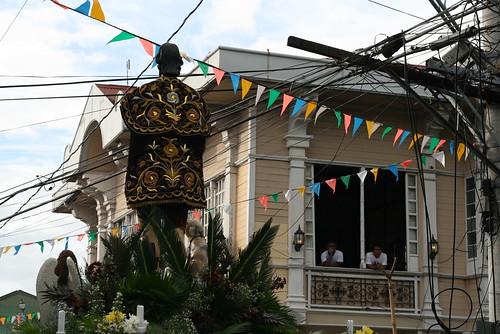
There's a certain drama that comes with tradition, and as the procession moves throughout the town past ancestral homes, their windows all open with spectators leaning over to watch like those that came before have done so, I am thankful for Pila's cultural advocates: the Pila Historical Society Foundation. The most prominent of them, Ms. Cora Relova, is a living reminder of the refinement and genteel manners the people of Pila have been known for since the time of the Spaniards. Her advocacy is to maintain Pila's status as a Heritage Town following the declaration of the National Historical Institute back in 2000. She welcomes people who have a heart for a town such as Pila, taking them along on heritage walks, armed with history, local lore, and a resolve to keep Pila the way it is. Who would not, if you get to wake up at a place like this?

If you think about it, the town of Pila is not like other Laguna towns that always has something associated with it; like say Pagsanjan or Los Baños which are resort towns, or Paete with carving and workworking, or Lumban with native textile and embroidery, etcetera. The town of Pila, plucked by the bay and moved to what was once an hacienda, would simply be like any other agricultural town made prosperous by the land. Yet somehow, there's this inexplicable draw that the place has over a jaded suburbanite such as I, maybe it's that combination of old world charm, a certain pride of place, and a people that you would fancy for their warmth and community spirit.

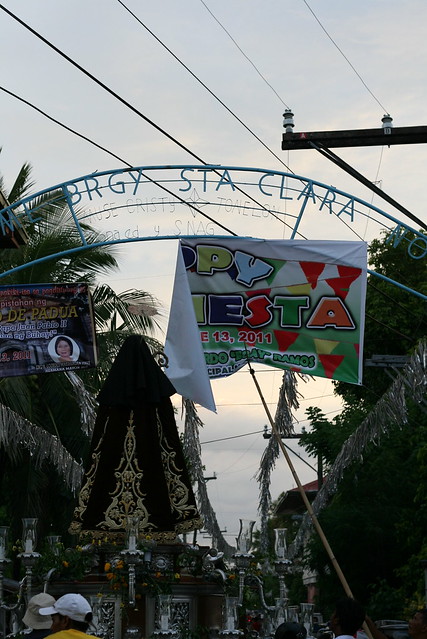
Before and after each procession come June 12 and 13, and I would look forward to watching the image of Santa Clara de Asis pass under the arch of Baranggay Santa Clara, it seemed a fitting and dramatic punctuation to the story of how Pila was relocated to a vast plantation then named Hacienda de Santa Clara. I relish the smile on my face as I watch thus, and with a prayer wish to be there again the next year.

For two years now, the fiesta processions of Pila would mark the end of my Processional Obligations, so to speak; which starts on Holy Week and encompasses Easter, the Feast of Saint Joseph, and the May-time Processions locally called Flores de Mayo. And Pila, with its charming historical homes and stunning processional images is a fitting finale. But without its people, the descendants of old families that would come home from halfway around the world for the sake of tradition, their cultural advocates, the devout men and women who help lend a hand in taking out the images of the saints, and the locals smiling amidst the constancy of their daily routines -all of them faithful and grateful- Pila would never be so blessed.

Until the next sojourn, I would like to thank:
Ms. Jessica Rivera
Dr. Rufino Francia
Manuel Djajakusuma
Ms. Cora Relova
Father Dennis Estrella
Paul Baisas Pagalanan
Jeffrey De la Paz
Tito Vic and the House of Victor Juan
and to the carroza pullers of Santa Clara de Asis
Thus spake the Barefoot Baklesa








 Posts
Posts


