Showing posts with label philippine art. Show all posts

25 June, 2011

Barefoot Sojourns: Pila, Ang Bayang Pinagpala


It's that time of year again, when I am called back to this beautiful place. Its vast central square surrounded by historic homes from an era past seems bathed by this golden light that slows down my weary and timeworn senses; shedding off the superficial shell that the city forces one to wear. Everywhere, even the faces of strangers turn into friends, and in their withdrawn yet polite smiles, comfort. Three years I have been coming back to this place, with one less stranger and a new friend made as I cross the streets, looking up at old house windows, praying inside Saint Anthony's brick and stone church, and enjoying the company of every new friend I have made.

Who would not fall in love with Pila?

This historic town that traces its name as far back as the 10th century [the date was April 21, 900 AD] when the place was still called 'Pailah' as mentioned in a small fragment of an engraved sheet of metal called the Laguna Copper Plate; which I first heard mention of during my History 165 class at the Ateneo. But it would not be another eight years before I would actually walk the streets of Pila, ascend the steps of its century old homes, and watch the early morning sun illuminate this blessed place from the window of one of its old houses owned by a family that has welcomed me three years hence.
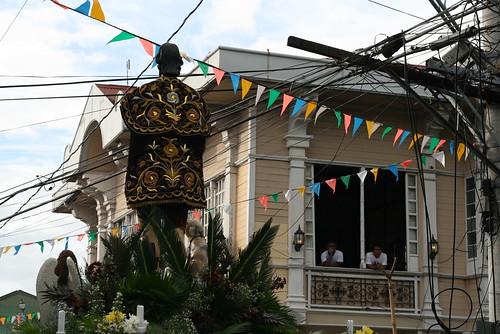


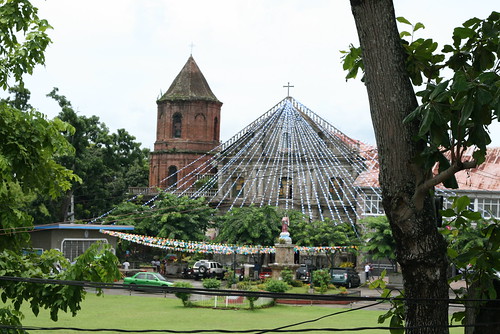
It was a rainy late afternoon when I arrived in Pila last June 11th, a day or so away from the annual celebration feast of San Antonio de Padua, the town's patron saint. Local lore has it that the Diocesan Shrine of San Antonio located at the edge of their Plaza Mayor [an old name for the central square, which is always more rectangular in the Philippines, I noticed] was actually transferred brick by brick and stone by stone from its old location by the lake, called Pagalangan of what is now the town of Victoria. It is said, during the Spanish colonial times, the Friars and the Luminaries of Pila decided to relocate the church due to the flooding of the Laguna de Bay. The new location, once known as Hacienda de Santa Clara, which was owned by the brothers Felizardo, Rafael, and Miguel de Rivera, is now the heart of modern day Pila. Without Don Felizardo Rivera's pioneering move, Pila would not have been. Rumor has it, the happy spirit of Don Felizardo still roams Pila, a sentinel of a time past.


It was three years ago when we were first invited by Ms. Jessica Rivera, one of the current heirs of the Rivera Ancestral House, to attend the annual Fiesta of San Antonio de Padua. Now for those of you who are uncommon to the Filipino tradition of celebrating a Fiesta, it's simply a community based celebration which has religious roots. Each town has a patron saint, and when the patron saint's feast day comes, it is celebrated with feasting and revelry to give thanks to the patron saint for gracing them with a good year of blessings and/or a good harvest. But I babble again...
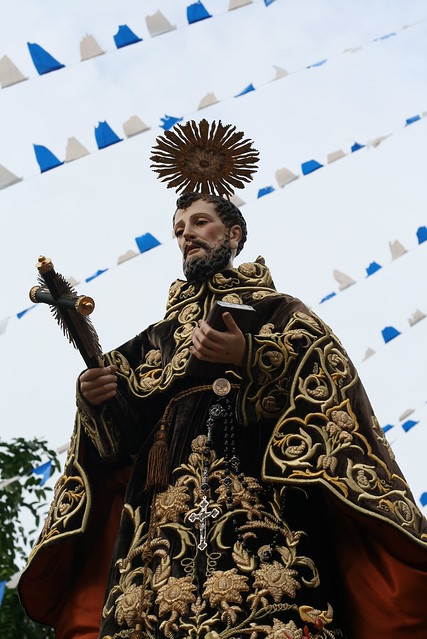


So, three years ago, a new found friend named Manuel [a distant relative of the Riveras] and I were invited by Miss Jessica Rivera for a traditional fiesta luncheon and the solemn procession of the image of San Antonio de Padua. Miss Rivera herself owns an image of San Francisco de Asis [the founder of the Franciscan Order] which accompanies San Antonio during his feast day procession along with the images of San Roque, and the Blessed Virgin Mary. It was an enjoyable experience and from then on, my fondness for the town of Pila began.


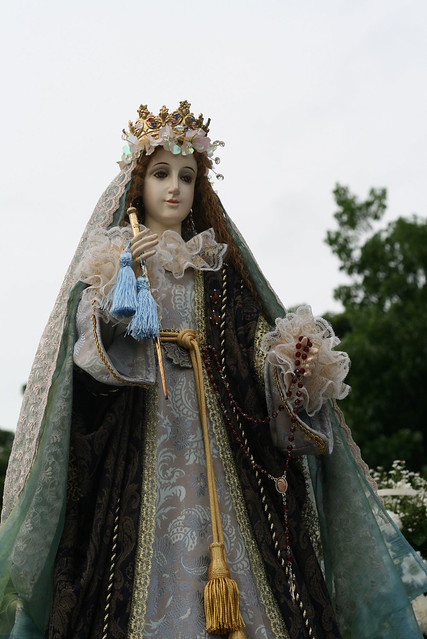
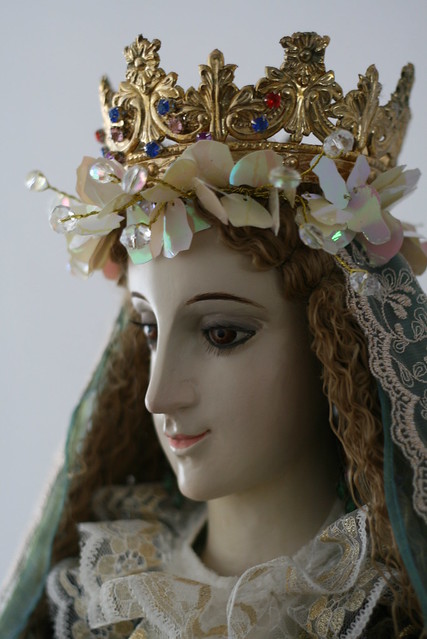
But Manuel felt that the processional images of San Antonio, San Francisco, and the others, must be accompanied by Santa Clara de Asis the next year, following the tradition that she is friend to San Francisco and took from his example. Add to that, since the town now stands where Hacienda de Santa Clara used to be, there was a certain serendipity. And come 2010, I began my devotion to what I call 'babysitting' Santa Clara de Asis. Manuel commissioned a processional image of the and founder and first abbess of the Poor Clares to join the procession in her saintly glory, while I volunteered to help supervise the logistics of taking out the image for procession ensuring that she arrives at the church door -inclusive of traversing bumpy roads, dodging electrical lines and festive buntings, and the occasional rain.
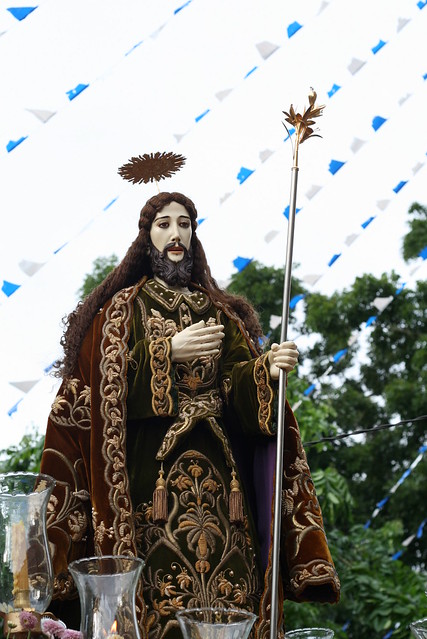


Meanwhile Doctor Rufino Francia, a cousin of Miss Jessica Rivera, also commissioned a processional image of Saint Joseph with face and hands made of ivory to escort the Blessed Virgin Mary. A stunning piece of statuary, Dr. Francia's San Jose was executed in the local sculptural style of the late 19th century wearing vestments of amber and green velvet embroidered with jilos de oro [metallic gold thread].


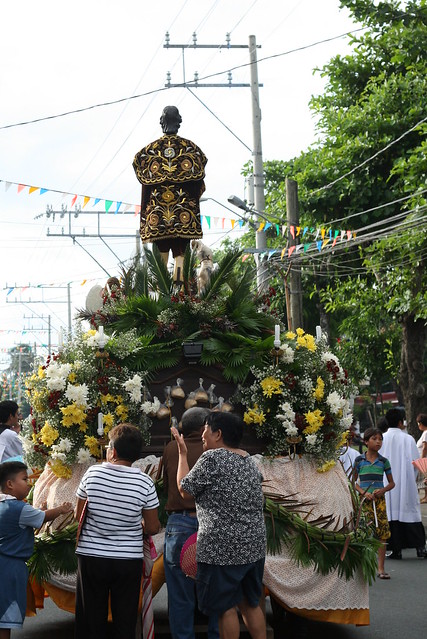
Another son of Pila, affectionately called Tito Vic, opens his home to the images of San Francisco, Santa Clara, San Jose, and the Blessed Virgin Mary. Under the old trees around his property, these sacred images make their temporary stop. The carrozas [wheeled processional mounts/platforms] are decked with flowers and other complimentary foliage, the arrangement artfully executed under the watchful eye of Tito Vic, making sure that every leaf and flower falls or stands rightly so. And after a full day's work, an hour before procession, the carrozas would make their way from his gates to the church courtyard, in their vibrant floral gloss.


There's a certain drama that comes with tradition, and as the procession moves throughout the town past ancestral homes, their windows all open with spectators leaning over to watch like those that came before have done so, I am thankful for Pila's cultural advocates: the Pila Historical Society Foundation. The most prominent of them, Ms. Cora Relova, is a living reminder of the refinement and genteel manners the people of Pila have been known for since the time of the Spaniards. Her advocacy is to maintain Pila's status as a Heritage Town following the declaration of the National Historical Institute back in 2000. She welcomes people who have a heart for a town such as Pila, taking them along on heritage walks, armed with history, local lore, and a resolve to keep Pila the way it is. Who would not, if you get to wake up at a place like this?


If you think about it, the town of Pila is not like other Laguna towns that always has something associated with it; like say Pagsanjan or Los Baños which are resort towns, or Paete with carving and workworking, or Lumban with native textile and embroidery, etcetera. The town of Pila, plucked by the bay and moved to what was once an hacienda, would simply be like any other agricultural town made prosperous by the land. Yet somehow, there's this inexplicable draw that the place has over a jaded suburbanite such as I, maybe it's that combination of old world charm, a certain pride of place, and a people that you would fancy for their warmth and community spirit.
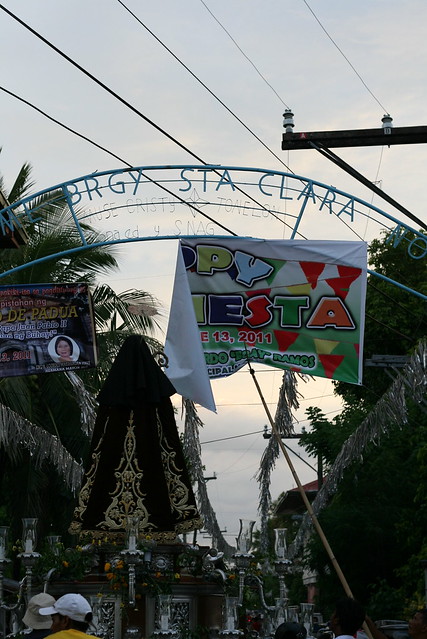


Before and after each procession come June 12 and 13, and I would look forward to watching the image of Santa Clara de Asis pass under the arch of Baranggay Santa Clara, it seemed a fitting and dramatic punctuation to the story of how Pila was relocated to a vast plantation then named Hacienda de Santa Clara. I relish the smile on my face as I watch thus, and with a prayer wish to be there again the next year.
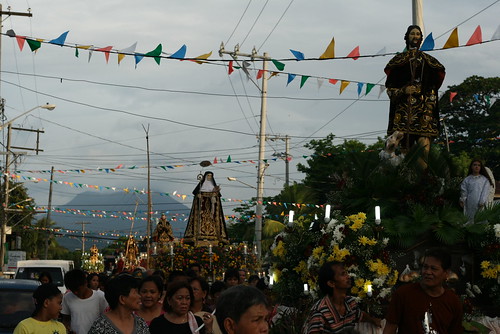


For two years now, the fiesta processions of Pila would mark the end of my Processional Obligations, so to speak; which starts on Holy Week and encompasses Easter, the Feast of Saint Joseph, and the May-time Processions locally called Flores de Mayo. And Pila, with its charming historical homes and stunning processional images is a fitting finale. But without its people, the descendants of old families that would come home from halfway around the world for the sake of tradition, their cultural advocates, the devout men and women who help lend a hand in taking out the images of the saints, and the locals smiling amidst the constancy of their daily routines -all of them faithful and grateful- Pila would never be so blessed.


Until the next sojourn, I would like to thank:
Ms. Jessica Rivera
Dr. Rufino Francia
Manuel Djajakusuma
Ms. Cora Relova
Father Dennis Estrella
Paul Baisas Pagalanan
Jeffrey De la Paz
Tito Vic and the House of Victor Juan
and to the carroza pullers of Santa Clara de Asis


Thus spake the Barefoot Baklesa

31 May, 2011

The Mary Month of May


In the Philippines, the month of May is always associated with three things: the start of the rainy season, the month of fiesta celebrations, and the devotion to the Holy Cross and the Flores de Mayo.

Superstition has it that it always rains on May 1st which is celebrated as the feast of Saint Joseph the Worker coinciding with the secular holiday: National Labor Day. They used to call the first showers 'Primera Lluvia de Mayo' [the First rain of May]. People would save the rainwater from that day and have it blessed to be used as holy water, believed to have healing properties.

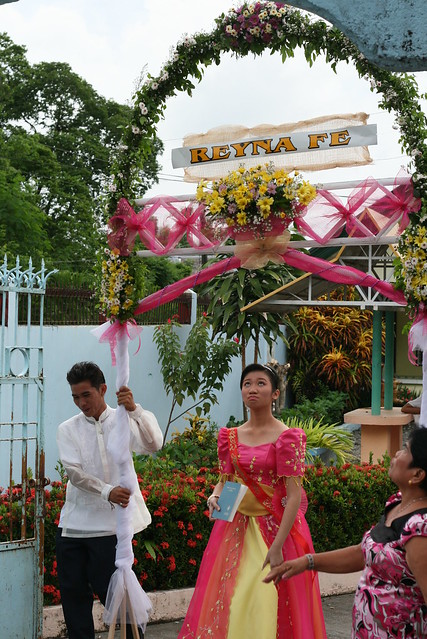
Then come May 3rd, the feast of the Holy Cross commemorates the finding of the true cross by the Empress Helena, mother of Constantine the Great. From hence, all over the country, for the remainder of the month, chapels and churches would be filled with the sound of prayers and hymns to the Blessed Virgin Mary as children offer her flowers every late afternoon in a ritual they call Flores de Mayo. While in some communities, a wooden cross is moved from house to house by little girls or young ladies until it reaches the house of the one chosen to be the Reyna Elena for the Santa Cruzan or Sagala, the annual promenade of little girls and young ladies dressed in the finest gowns paraded with arches decorated with flowers in commemoration of the Pilgrimage to find the true cross.


Actually, the Santa Cruzan and the Flores de Mayo are two different things: The Flores de Mayo is an act of devotion to the Blessed Virgin Mary culminating with a procession at the end of the month; while the Santa Cruzan started out as a pageant of sorts to showcase the eligible young women as they represent characters in the christian legend. But somehow, in the last thirty years, the two have merged into one unique hodgepodge of an event. The titles of the Virgin Mary like Rosa Mystica [Mystic Rose] or Reyna de las Estrellas [Queen of the Stars] is mixed with Characters like Reyna Banderada [the Motherland], Infanta Judith [the biblical Judith with a severed head], Reyna Elena [Empress Helena] and in some towns, Cleopatra -which i have seen reclining on a palanquin.

Celebrated Cultural writer Gilda Cordero Fernando could not contain her amusement when once shown photographs and regaled with the often incongruous line-ups of the Santa Cruzan or Sagalas of late. But she is forgiving in saying, "Hayaan mo na, it's sooo Folk eh." [Leave it be, It's so Folk].


Folk indeed, as I myself often could not make heads or tails of it yet find it uniquely Filipino. Some people find the Santa Cruzan irrelevant nowadays; a remnant of bygone era that has been consumed by displays of vanity and fundraising activities. But in some towns, they still cling to it, as tool of faith and the retelling of one dramatic chapter in the story of Christianity -and that to me, is better than showbiz celebrities paraded about town upstaging the Blessed Mother and the lessons of early Christian legend. Here's to that, and to the Blessed Virgin Mary.


thus spake the Barefoot Baklesa

16 June, 2010

i left my heart in Pila


I had a great time during the feast of Saint Anthony of Padua in Pila Laguna this past weekend... I was babysitting my friend's Santa Clara de Asis for her primera salida procession... Pila is such a place that inspires the romance of days gone by, and I fell in love with Pila long before i knew the people that lived within those century-old homes.

I think I left my heart in Pila Laguna


thus spake the Barefoot Baklesa

22 May, 2010

Baking in the National Library


IF I HAVE TAGGED YOU, PLEASE TAKE THE TIME TO READ THIS…AND SERIOUSLY TELL ME WHAT YOU THINK… AND IF IT MAKES SENSE, PASS IT ON


I have just finished watching this little known movie entitled AGORA about the siege the early Christians laid upon the Great Library of Alexandria at the fourth century when the Roman Empire had recognized Christianity as the official religion of the empire. And how the female philosopher, Hipatia, struggled to keep the knowledge of the ancient world alive amidst the zealous acts that leave such chaos at its wake.

BUT THIS IS NOT ABOUT RELIGION, THIS IS ABOUT IRONY

Just a few hours ago, I had spent almost a day at the National Library of the Philippines. To those of you who have known me through Jesuit University and that other school across that university along Taft Avenue, if you can’t find me anywhere else, I usually am at the library not to catch a snooze but to explore the stacks and read the rest of the day away.

As I entered that Bauhaus structure along T.M. Kalaw Avenue at probably one of the hottest days of this summer, the sparse lobby gave no impression that within these walls, the people of this nation will behold before them such wonders found only in printed bound parchment that those who have dared contain them there laboured that we may know the tangible and intangible world by ways never revealed to us before.

Truth be told, that last sentence had more in it than what that place could have offered me. As I applied for my reading card which cost me only 50 pesos [almost $1 US], the insufferable heat in that place could not ruin my resolve to gain access to a few books that I needed which were currently out of circulation.

In my quest for reference books for the research on this book I’m developing with another writer, I was led to the online catalogue of the National Library since the rare books I was looking for cost an arm and a leg for $300 on the internet. I’m not a cheapskate, but the contents I needed from pages those books are all up here in the swirling primordial mist that is my mind -I just needed them for footnoting.

As I went into the reading rooms, and through the stacks to look for what I needed, I could not help but stare at the state that place was in. The place was clean as libraries go, but the disrepair, the poorly maintained stacks, and the general atmosphere of the place akin to that of a backwater town that government funding forgot.

As I walked those halls, It did not seem to me that this was the place that held almost everything about the world since the first movable type. What is this place to be for some impressionable youth seeking to fuel himself in the arts and sciences? One could argue that what really matters is what is inside those books and not the place that hold them. But if the place lacks the very books that can take them onto this journey -No, that the one that sends Bastian into Fantasia but you get my drift- then what?

BUT IS NOT THE STATE OF A COUNTRY’S BIBLIOTEQUE A REFLECTION OF WHAT IT IS?

Is this neglect associated with the priorities of every government that came and went? In the middle of my research I composed a text message that I sent to my mentors in the hopes that they may at least help me make sense of the experience.

“Sitting here at the National Library, a week after elections and just before the new come to take office, I wonder what will a new president really do for the Arts? To be specific, what does it matter to my art now that the people seem to have found hope and change in a man who is also of the old order?”

And this was the most disturbing reply

“Anak, ano ba naman ang alam niya sa Sining natin? The Arts have always been the least of any leader’s priorities since I can’t remember. If anything, the Arts to him may be just like tonight’s latest “gossip” that would be replaced with another juicier one by tomorrow. Palibhasa gossip rin lang naman ang alam ng kapatid niyan and I’m afraid they may play the Arts card when it is to their advantage like a badly acted teleserye”

And there I was, sitting on one of the wooden tables at the end of the Filipiniana section telling myself once again, that a place such as this should be the beacon for those wide-eyed youth seeking to be inspired, seeking to understand the world, and be fueled to contribute to the Sciences and most especially the Arts. No matter how disheartening that text message was.

That place must contain the infinite variety of the world as it is seen not by just one eye. For how are we to flourish if we do not at least leave a generation of new thinkers and even madmen that would challenge the way we see the world.

In our little corners, we [the few who still dare] try to keep the Arts alive. But what is Art without the interdisciplinary understanding of it? Are we to entrust that to the fantaseryes and teleseryes on recent vintage? When the fame of our world class performers are all limited to talent within the framework of western material, where is the emergence Filipino Identity in this global melting pot? It’s not there because there is nothing to catalyse it.

A few new computers with LCD screens does not a state of the art facility make.

I fear we are just fostering a wikipedia and “cut & paste” next generation if the very places that should contain the world for them only contain an island; leaving the rest of it to be googled away.

When forced to abandon her quest to keep teaching, Hipatia then says, “Sinesias, you do not question what you believe, or cannot… I MUST.”

I THEN QUESTION THIS HOPE AND CHANGE PEOPLE ARE NOW INEBRIATED WITH.

Because, what is that to me who struggles to create illusion within a proscenium frame to suspend any disbelief? Because what is that to me who seeks to add to that ISBN list with something that I see as uniquely Filipino?

If the mandate of the people is indeed for the good of everyone, what does that vote translate to us? Are they expecting us to be the sacrificed so that the many may be prioritized? Or are they expecting us to run for Party List seats in congress so we may finally be heard?

I may not see the National Library to be the like the Biblioteque of Alexndria any time soon. As it currently fails to deliver that brand of awe that a place where knowledge and things in their infinite variety may be discovered anew. The only saving grace of that place, are its employees. The people working there, under the dismal circumstances, are testaments to the resilience that we Filipinos are known for. That petite lady with the glasses at the special collections gives me a better appreciation of what a civil servant has to endure.

The change that you have been promised is not something that can come overnight. But if you don’t really voice out what needs to be changed, then the priorities just won’t get listed.

I remember something important about the Dark Ages, when the rest of the world falls into this hype of change that often results in chaos, there are those that retreat to the halls of learning and chambers of knowledge translating the knowledge of the old world so that there would be enough of them to spark the Renaissance.

Maybe I’m thinking of gloom and doom too much too soon… But if in six years, that structure along T.M. Kalaw remains as it is, then corruption is really the least of this nation’s concerns.

Go ahead, ask the average Filipino teenager who Idianale, Magwayen, Tungkung-Langit, Alunsina or Lakampati are, and you would not be surprised that they know more about Aphrodite and Apollo. Maybe even you who are reading this won’t even know off the bat.

I will be announcing “eating my piece of humble pie” if anything is bound to change at all.


thus spake the barefoot baklesa

03 June, 2009

the barefoot baklesa meets Gilda Cordero-Fernando


Today was one of those days that started out as something that would not seem to go the way I would want it to. First, i woke up a little later than I had intended, was still a little feverish, ran out of oatmeal, and had no milk for my wheatbix either...

There were still a few errands to run, and I had to meet my friend Owee for a project we were doing together. Unfortunately, the snail's pace traffic flow of the South Luzon Expressway was not of any help either.

Well, as it turns out, Owee was supposed to meet one of Filipino Literature's most influential figures: Gilda Cordero-Fernando. A well-known publisher and author responsible for books like: Turn of the Century, The Body Book, The Soul Book, Cuaresma, and others that currently escape my memory. In short, Gilda Cordero-Fernando's books have influenced my identity as a Filipino design artist.

Truth be told, we were just there to negotiate for her involvement in a photography book. What started out as an afternoon with buco pandan and coffee transitioned into dinner and dessert! Negotiating took less than half an hour at my count, and the three hours beyond that, indescribable.

Conversation, Ideas, Theories, Sentiments on Filipino Culture and Identity, and Laughter all seem in place, in her home, which is in itself a testament to Philippine Art. Not even her heirloom ivory crucifix encased within a glass dome could distract me.

It felt as if this woman whom I held in high esteem, since the first time I have read her books, was like a kindred soul found in this sea of absurdities and farces that artists like me experience in the humdrum of the daily grind; lost in a murky sea lacking any inspiration with certain dreams put on hold.

I do hope I'm making sense here... I'm just clearly, in plain terms, starstruck!

She's such a cool Lola!

By the evening's end, she had one of her attendants take out copies of The Body Book and signed it herself, presenting them as gifts to two young artists who felt so energized with those three -call it- magical hours.


When we got into the car, I went, "Whaaaaaaahhhhhhhh!!!!"
Trust me, I seem to have run out of words at that time. Here we are, five hours later, thinking this blog does not feel sufficient to describe the experience.

thus spake the Barefoot Baklesa